
In today’s modern society, where electricity supply is highly reliable, diesel generators might seem somewhat outdated, but in reality, they remain an indispensable emergency or backup power source in many situations. Whether deep inside a mine, at a remote construction site, or in critical facilities such as hospitals and data centers, diesel generators serve as the unsung heroes safeguarding power supply. However, selecting a suitable diesel generator is not easy, especially when it comes to choosing the appropriate power rating. Many users are often confused and may even be misled by unscrupulous vendors. Today, we will take an in-depth look at the key points of diesel generator power selection and how to accurately calculate load, helping you choose a generator that perfectly meets your needs.
When selecting a diesel generator, power is a core parameter but also the one most easily misunderstood. In China, we usually use prime power (also called continuous power or long-term power) to indicate the generator’s capacity. Simply put, it refers to the maximum power the generator can continuously supply over 24 hours. For example, a generator with a prime power of 400 kW can, in theory, continuously and stably supply 400 kW of power over 24 hours.
However, internationally, most generators are labeled with standby power (also called maximum power). Standby power refers to the capacity the generator can supply for a certain period, usually defined as one hour within a 12-hour period at 10% above the continuous power. In other words, if a generator has a prime power of 400 kW, it can run at 440 kW for one hour within 12 hours, and this 440 kW is the standby power.
The problem arises when some irresponsible manufacturers advertise maximum power as continuous power to attract customers. This causes many users to mistakenly believe they are buying a generator capable of continuously and stably outputting 400 kW. In reality, if the 400 kW rating is standby power, the actual prime power is only 360 kW. Running it continuously at 400 kW would mean the generator is constantly overloaded, significantly shortening its lifespan and increasing failure rates.
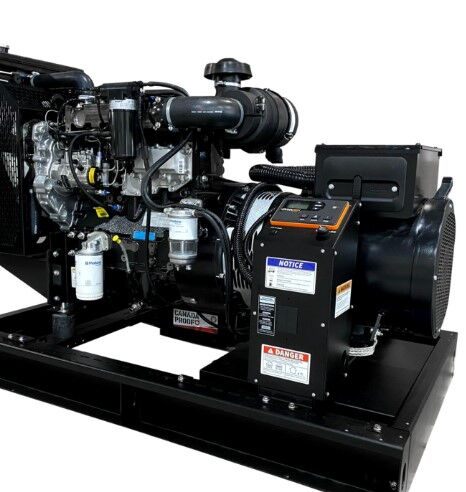
So, how should one correctly choose the power rating of a diesel generator? Generally, power selection should be based on the total load plus a 10% power reserve. This approach is both economical and practical, ensuring that the generator has a margin to cope with unexpected situations. For example, if a user calculates a total load of 100 kW, they should consider a diesel generator with a prime power of 110 kW.
There is also a conversion relationship between prime power and standby power. If a user requires a diesel generator with a prime power of 100 kW, the standby power should be 100 kW × 110% = 110 kW. Conversely, if a diesel generator has a standby power of 100 kW, its prime power would be around 90 kW. Understanding this relationship helps accurately determine whether a generator meets actual requirements when encountering different power ratings.
Load calculation is a crucial step before selecting a diesel generator. Only by accurately calculating the load can the appropriate generator power be determined. Loads are mainly divided into resistive loads and inductive loads.
- Resistive loads: Resistive loads are relatively simple, such as common incandescent lights, electric heaters, and kettles. The starting power equals the operating power. For example, a 1000 W electric heater requires 1000 W both at startup and during normal operation.
- Inductive loads: Inductive loads are more complex, including electric motors, compressors, pumps, air conditioners, and so on. These loads require additional startup power, with starting current possibly 3–7 times the operating current. For example, a motor with a rated power of 5 kW may have a starting current five times its operating current, so the starting power must be calculated based on the starting current.
- Operating power: Operating power refers to the power required when the equipment is running normally. This is the most basic data. When calculating total power, we need to sum the operating power of all devices that may be used simultaneously. For example, if a factory has five devices with operating powers P1, P2, P3…, the total operating power is P1 + P2 + P3 + … This value directly affects the selection of the generator’s prime power.
- Starting method: Different starting methods have significant differences in starting current requirements. Common starting methods include direct-on-line (DOL), star-delta, soft starter, and variable frequency drive (VFD) start. DOL has the largest impact, with starting current around 7 times operating current; star-delta is about 3 times; soft starter about 2 times; and VFD essentially has no surge, with starting current around 1.2 times. Understanding the starting method is essential for calculating maximum surge power.
- Starting power: For motor-type loads, it is necessary to calculate the apparent power required at startup. The formula is:
Motor starting kVA = (Rated Voltage × Starting Current × 1.732) ÷ 1000
To simplify, we can use empirical factors:
- Direct start: starting kVA = rated motor power (kW) × 7
- Star-delta: starting kVA = rated motor power (kW) × 3
- Soft starter: starting kVA = rated motor power (kW) × 2
- VFD: starting kVA = rated motor power (kW) × 1.2
Calculating steady-state total power: Add the operating power of all devices that may operate simultaneously to obtain the total running power. This value must be less than the generator’s prime power to ensure it is not overloaded during normal operation.
Calculating maximum surge power: Identify the motor with the highest starting impact, calculate its starting kVA, then subtract its operating power from the steady-state total and add the motor’s starting kVA to obtain the maximum instantaneous power. This value must be less than the generator’s transient overload capacity to ensure the generator is not damaged by overload when starting equipment. Typically, high-quality generators can withstand short-term overloads (a few seconds) of about 150–200% of rated power. However, this cannot be estimated simply by multiplying the nameplate power by 1.5; the generator’s technical manual must be consulted to determine the actual transient overload capacity.
After understanding the key points of diesel generator power selection and load calculation, we can provide more targeted recommendations based on different application scenarios. Different environments and requirements have distinct power and performance needs, so understanding these scenarios is critical for making rational choices.
In mines and remote construction sites, equipment is often dispersed, and the working environment is harsh. Common loads include various power tools, small excavators, and lighting equipment. These sites typically require a moderately powered diesel generator as a temporary power source. Due to large startup surges, it is recommended to add a power reserve when calculating total load. For example, if the calculated total load is 50 kW, considering startup surges and equipment reliability, a generator with a prime power of about 70 kW is recommended.
Hospitals and data centers have extremely high requirements for power reliability. Diesel generators are usually used as backup power. Hospitals, in addition to conventional lighting and office equipment, have numerous medical devices such as X-ray machines and CT scanners, which demand high starting currents. Data centers have large numbers of servers, and although individual server power is not high, their quantity and startup current surges are considerable. For these sites, it is recommended to choose a higher-powered generator and ensure its transient overload capacity meets the startup demands. For example, a medium-sized data center with a total load around 200 kW should have a generator with at least 220 kW prime power as backup.
Factories and enterprises have diverse equipment with varying power levels, from large machine tools to small office equipment. When calculating load, pay special attention to the starting method and starting power of large equipment. For example, a machining factory with several large CNC machines, each rated at 20 kW and using direct start, would require each machine’s startup power to be calculated as 140 kVA. The operating power of other equipment must also be considered, and the generator should be selected based on the total calculation. Generally, factory generators range from several hundred kW to over 1 MW, depending on actual equipment conditions.
- Choose Reputable Manufacturers: Always select generators from legitimate manufacturers. Reputable manufacturers not only guarantee product quality but also provide more complete after-sales service. Avoid low-quality products that misrepresent power ratings to prevent unnecessary trouble and financial loss.
- Understand Technical Parameters: Besides power, carefully review other technical specifications, such as fuel consumption, noise levels, and emission standards. These parameters directly affect operating costs and environmental performance. For example, a generator with lower fuel consumption saves significant fuel costs over long-term operation, while a quieter generator is preferable in noise-sensitive locations.
- Consider Maintenance: Regular maintenance is essential to prolong generator life and reduce failure rates. Understand maintenance intervals and requirements, and select generators that are easy and cost-effective to maintain. Also, consider the local after-sales service network to ensure timely technical support when repairs are needed.
As an important backup or temporary power source, diesel generators are widely used in many fields. However, selecting a suitable generator is not easy, especially regarding power selection. It requires understanding differences in power ratings, accurately calculating load, and determining appropriate power based on actual application scenarios. This guide aims to help you select a diesel generator with confidence, avoiding misleading vendors and ensuring the generator reliably meets your needs, providing secure power for production and daily operations. During selection, exercise caution, make comparisons, and consult professionals. Only by doing so can you ensure that your diesel generator will perform as needed in critical moments, rather than becoming an idle installation or burden.
