
In power systems, the diesel generator is the core equipment for supplying electrical energy. Electrical appliances used in daily life have strict requirements for voltage and frequency stability. Excessively high voltage may damage electrical devices, while unstable frequency can cause precision equipment to malfunction. The stability of diesel generator output voltage and frequency depends directly on the stability of rotational speed. Only when the diesel generator operates at a constant rated speed can stable and reliable electrical power be delivered. Therefore, the speed governor is an indispensable component of a diesel generator set. Whether for large power stations or standby emergency diesel generators, an appropriate speed control device is essential. The primary function of a governor is to monitor diesel generator speed in real time and regulate fuel supply to maintain constant rotational speed, thereby ensuring high-quality power output.
To understand the working mechanism of a governor, it is necessary to first clarify the relationship between rotational speed and throttle position. Regardless of the governor type, speed regulation is ultimately achieved by controlling the fuel supply through throttle adjustment.
Increasing the throttle opening → more fuel supply → stronger engine power → higher rotational speed
Reducing the throttle opening → less fuel supply → weaker engine power → lower rotational speed
After the diesel generator starts, the rotational speed must gradually increase from a stationary state to the rated speed. During this process, the governor continuously adjusts the throttle opening until the diesel generator operates steadily at the rated speed. When the load changes, such as when additional electrical equipment is connected, speed fluctuations may occur. The governor immediately detects these changes and adjusts the throttle to restore the preset speed.
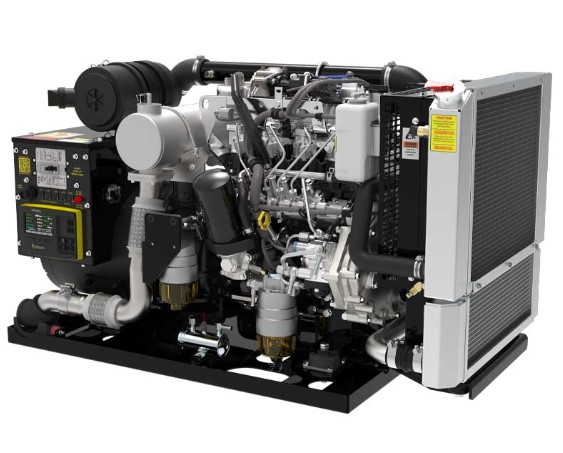
After understanding the basic function and speed control principle, we examine the mechanical governor, the earliest and still widely used speed regulation device. As the most traditional technology, it remains the preferred choice in many applications due to its simple structure and independence from external power supply.
The mechanical governor is the earliest and most widely used speed control device. Its core operating principle is based on centrifugal force physics. Inside the mechanical governor are a pair of flyweights connected through a linkage mechanism to the fuel injection pump rack.
During diesel generator operation, the flyweights rotate together with the engine shaft and generate centrifugal force.
When rotational speed increases, centrifugal force acting on the flyweights also increases, pushing them outward. Through the lever mechanism, the fuel rack is pulled toward the fuel reduction direction, decreasing fuel supply and lowering speed.
When rotational speed decreases, centrifugal force acting on the flyweights decreases. Under spring tension, the flyweights move inward, pushing the fuel rack toward the fuel increase direction, raising fuel supply and restoring speed.
Through this mechanical feedback mechanism, the mechanical governor can automatically maintain speed fluctuations within an acceptable range.
Mechanical governors are usually equipped with the following adjustment devices:
Main adjustment screw or knob: used to set the target rotational speed by changing the preload force of the governor spring.
Clockwise rotation increases spring preload and raises the set speed.
Counterclockwise rotation reduces spring preload and lowers the set speed.
Fine adjustment device: Some mechanical governors are equipped with precision adjustment mechanisms such as adjusting nuts or sliding stops. By finely tuning the movement range of the flyweights, fuel supply can be controlled more precisely and speed fluctuation can be reduced. However, such fine adjustment requires operational experience and skill.
Simple structure without complex electronic components, resulting in low failure rate
High reliability and mature technology proven through long-term practice
High independence, requiring no external power supply and capable of operating during total power failure
Strong environmental adaptability, allowing stable operation in high temperature, high humidity, and dusty conditions
Limited regulation precision due to mechanical clearance and friction, typically causing small speed fluctuations
Slow response speed because mechanical inertia requires time to sense speed variation and complete adjustment
Mechanical wear may occur after long-term use, which can gradually degrade governor performance
Manual on-site adjustment is required, making remote control or automation impossible
With the increasing demand for power quality in electrical systems and the rapid development of automation control technology, electronic governors have gradually become the mainstream configuration of modern diesel generator sets. Compared with mechanical governors, electronic governors use electronic signals instead of mechanical transmission, achieving significant improvements in regulation accuracy and response speed.
Electronic governors represent the development direction of speed control technology. They completely eliminate the mechanical flyweight structure and adopt electronic signal control for speed regulation. The core working process is as follows:
Signal acquisition: The speed sensor (usually a magnetic induction sensor) monitors diesel engine speed in real time and converts mechanical rotation speed into an AC voltage signal. Load sensors detect load variations and convert them into DC voltage signals.
Signal processing: The speed control unit, which is the core controller, receives sensor signals and compares them with the preset speed value.
Actuator control: Based on the difference signal, the controller drives the actuator (servo motor or electromagnetic actuator) to move the fuel rack for fuel increase or reduction.
According to control signal characteristics, electronic governors can be divided into two types.
Single-pulse electronic governor: It regulates based only on rotational speed pulse signals. Adjustment occurs only after speed variation is detected. This structure is relatively simple and cost-effective but offers limited regulation accuracy.
Dual-pulse electronic governor: It collects both speed and load signals simultaneously and superimposes them for regulation. The advantage lies in predictive control—when load changes occur but rotational speed has not yet changed, the load sensor detects the variation and adjusts fuel supply in advance. This feedforward-plus-feedback control method improves regulation accuracy and helps maintain frequency stability, making it especially suitable for applications with high power quality requirements.
Important note: Electronic governors require a stable power supply, which is fundamentally different from mechanical governors.
For emergency diesel generators equipped with electronic governors, two independent battery groups must be installed.
The first battery group is dedicated to powering the electronic governor to ensure continuous operation of the speed control system.
The second battery group is used for diesel generator starting.
These two battery groups must not be shared. If an emergency diesel generator loses governor function due to insufficient battery power during operation, speed control failure may occur, which can be extremely dangerous.
Electronic governors provide multiple flexible adjustment approaches:
Local digital adjustment: Target speed can be directly input through digital buttons or knobs on the control panel. The governor automatically calculates and adjusts fuel supply to reach the preset speed precisely. The operation is simple and intuitive.
Integrated automatic adjustment: Advanced electronic governors can be integrated with diesel generator monitoring systems to achieve fully automatic regulation. For example, in grid-connected diesel generator operation, the governor can automatically optimize rotational speed based on grid frequency and load variation.
Remote monitoring and control: Through communication interfaces such as RS485 or Ethernet, operators can monitor speed status in real time from a remote control center and adjust parameters, significantly improving management efficiency.
High regulation precision with static and dynamic performance far superior to mechanical governors
Fast response speed, allowing millisecond-level adjustment without mechanical inertia
Rich functional capabilities including overspeed protection, underspeed protection, and fault diagnosis
Compact structure, easy installation, and small footprint
Highly suitable for automation and unmanned operation
Dependence on reliable power supply, with functional failure occurring during power outage
Environmental sensitivity of electronic components to high temperature, humidity, and electromagnetic interference
Relatively complex structure involving sensors, controllers, and actuators
Higher procurement and maintenance costs.
For high-power diesel generator sets, the driving force of mechanical governors is limited, and the actuator capability of electronic governors may be insufficient to handle large fuel flow regulation. In this case, hydraulic governors become the professional choice for large-capacity diesel generator sets due to their strong output force and excellent stability.
Hydraulic governors combine mechanical sensing and hydraulic actuation advantages and are mainly used in high-power diesel generator sets.
When speed changes occur, centrifugal mechanisms or other sensors generate control signals that drive the hydraulic pump to change oil pressure and flow direction. High-pressure hydraulic oil enters the servo motor (hydraulic cylinder), pushing the piston to move and thereby adjusting fuel injection flow.
For example, when speed increases, the hydraulic system controls the servo motor to reduce the fuel inlet opening of the injection pump. When speed decreases, the opening is increased to achieve closed-loop speed control.
Hydraulic governor regulation is mainly achieved through the following devices:
Hydraulic parameter adjustment:
Relief valve — adjusts the working pressure range of the hydraulic system, changing the output force and response speed of the servo motor
Throttle valve — controls oil flow and governor response speed
Speed setting adjustment is achieved by regulating the spring tension to establish the reference speed. When actual speed deviates from the reference value, proportional regulation is automatically performed based on deviation magnitude.
Advantages: Strong regulation force, allowing hydraulic systems to easily control fuel supply in high-power diesel engines; Stable transmission with smooth regulation process and no mechanical impact; Relatively high precision combining mechanical sensing reliability and hydraulic actuation accuracy.
Limitations: Complex structure involving oil pumps, cylinders, pipelines, and valves; High maintenance requirements, including regular inspection of hydraulic oil quality, oil level, and system sealing to prevent leakage and contamination; Difficult fault diagnosis due to the concealed nature of hydraulic system failures; High manufacturing and maintenance costs.
Item | Mechanical Governor | Electronic Governor | Hydraulic Governor |
Working principle | Centrifugal force-mechanical linkage | Electronic sensor-controller-actuator | Centrifugal-hydraulic transmission |
Power supply | Not required | Required | Not required |
Regulation accuracy | General (±1–2%) | High (±0.25–0.5%) | Relatively high (±0.5–1%) |
Response speed | Slow (second level) | Fast (millisecond level) | Medium |
Applicable power | Small to medium | All power ranges | Large power |
Environmental adaptability | Strong | Moderate (requires protection) | Medium |
Maintenance difficulty | Low | Medium | High |
Cost | Low | Medium | High |
Automation level | Low | High | Medium |
For emergency diesel generators equipped with electronic governors, one critical configuration is often overlooked: two independent battery groups must be installed.
The first battery group (dedicated to governor power supply) provides continuous and stable power for the electronic governor, ensuring long-term operation. This battery is not used for engine starting.
The second battery group is dedicated to engine starting and must meet the high-current discharge requirements of the starter motor.
The starter motor draws extremely high current (hundreds of amperes), causing a sharp voltage drop
If the governor and starter motor share the same power supply, voltage sag during starting may cause governor reboot or malfunction
If the governor fails during the starting process, the diesel engine may overspeed, leading to equipment damage or safety accidents
Therefore, in the design and maintenance of emergency diesel generator systems, these two battery groups must be strictly separated, independently configured, regularly maintained, and monitored for charge status.
The diesel generator governor is a critical component for ensuring power quality. Mechanical, electronic, and hydraulic governors each have their own application scenarios. Mechanical governors are simple and reliable, suitable for harsh environments and general applications. Electronic governors offer high precision and intelligence, meeting the demands of high-quality power supply and automation. Hydraulic governors provide strong actuation force and are specially designed for high-power diesel generator sets. In practical selection, factors such as power rating, accuracy requirements, environmental conditions, budget, and maintenance capability should be comprehensively considered. It is particularly important to note that although electronic governors offer superior performance, an independent power supply system must be provided, which is crucial in emergency diesel generator configurations.
