
A diesel generator set is a power supply device that uses a diesel engine as the power source and generates electrical energy by driving a synchronous generator. Simply put, it is a mechanical device that converts the chemical energy of diesel fuel into electrical energy. This equipment features fast starting speed, relatively convenient operation and maintenance, relatively low initial investment, and strong adaptability to various environmental conditions. Therefore, it is widely used as an important power supply solution in many situations.
From a structural perspective, a diesel generator set belongs to a type of self-contained power station AC power supply equipment and is a small independent power generation device. It uses a diesel engine as the power core to drive a synchronous AC generator to operate, thereby generating the alternating current we use in daily life.
Modern diesel generator sets are not a single device but a rigid whole composed of multiple key components. The main parts include the following:
- Diesel engine: This is the power source of the entire unit and is responsible for converting the heat energy produced by diesel combustion into mechanical energy.
- Three-phase AC brushless synchronous generator: Also known as an alternator, it is responsible for converting mechanical energy into electrical energy.
- Control box (panel): Used to monitor and control the operating status of the generator set, including the display and protection of parameters such as voltage, frequency, oil pressure, and water temperature.
- Cooling water tank (radiator): Provides cooling for the diesel engine to prevent the engine from overheating.
- Coupling: The transmission component that connects the diesel engine and the generator.
- Fuel tank: Stores diesel fuel.
- Silencer: Reduces the exhaust noise of the diesel engine.
- Common base frame: The foundational frame that fixes all components together.
In terms of installation, the flywheel housing of the diesel engine is directly connected to the front cover of the generator through a spigot positioning structure. A cylindrical elastic coupling is used to drive the generator to rotate directly from the flywheel, and the two are fixed together with screws. This design ensures that the concentricity of the diesel engine crankshaft and the generator rotor remains within the specified range, ensuring smooth operation.
In order to reduce vibration during the operation of the generator set, shock absorbers or rubber vibration pads are usually installed at the connection points between the major components such as the diesel engine, generator, water tank, and electrical control box and the common base frame.
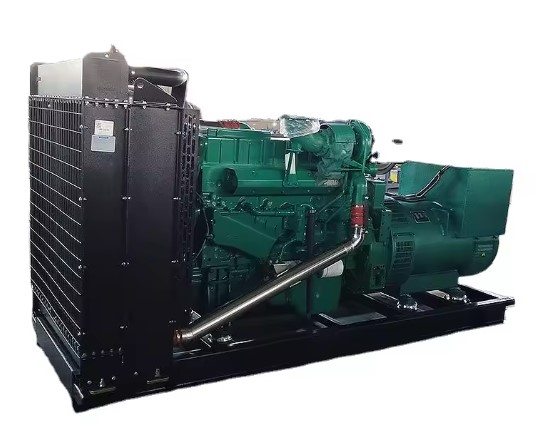
The operation of a diesel generator set is essentially an energy conversion process. It consists of two main mechanical parts: the engine (diesel engine) and the generator (AC generator).
The engine provides mechanical energy, also known as kinetic energy. It is the part of the entire system that produces power.
The generator is responsible for converting mechanical energy into electrical energy. It should be clearly understood that the generator itself does not create electrical energy; it only converts one form of energy into another form.
Specifically, the diesel generator set converts the energy generated by mechanical motion into electrical energy through the force of movement. The entire process can be summarized as follows: the moving components of the engine generate power, this power is transmitted into the circuit, the generator draws current from the circuit, and then directs the current into the transmission line, finally delivering it to the electrical equipment.
The process by which a diesel generator set converts diesel energy into electrical energy mainly occurs inside the cylinders of the diesel engine and can be divided into the following steps:
- Intake and mixing: Air first passes through the air filter to remove dust and impurities, producing clean air. At the same time, the injector sprays diesel fuel into the cylinder in the form of high-pressure atomization. The clean air and the high-pressure atomized diesel fuel mix fully inside the cylinder to form a combustible mixture.
- Compression and heating: The piston moves upward to compress the mixture. As the volume decreases, the temperature and pressure of the mixture rise rapidly. When the temperature reaches the ignition point of diesel (about 220°C), the conditions for ignition are met.
- Combustion and power generation: Diesel is ignited (diesel engines use compression ignition and do not require spark plugs), and the mixture burns violently. The volume expands rapidly, producing high-temperature and high-pressure gases. These gases push the piston downward. This process is called the “power stroke.” The force of the piston is transmitted to the crankshaft through the connecting rod, becoming the force that drives the crankshaft to rotate.
- Continuous cycle operation: Multiple cylinders perform work sequentially according to a certain ignition order, continuously driving the crankshaft to rotate. The rotational motion of the crankshaft is the mechanical energy we need.
- Electromagnetic induction power generation: The brushless synchronous AC generator is coaxially installed with the crankshaft of the diesel engine. When the diesel engine drives the generator rotor to rotate, an induced electromotive force is generated inside the generator according to the principle of electromagnetic induction. When a load is connected to form a closed circuit, current is output, thus achieving the conversion from mechanical energy to electrical energy.
The combustion of diesel in the cylinder is a complex physical and chemical change process. The quality of combustion directly affects the working capacity, thermal efficiency, and service life of the diesel engine. The entire combustion process can be further divided into four stages:
- Ignition delay period (combustion preparation stage): This is the period from when the fuel is injected into the cylinder to the start of ignition. During this stage, the fuel completes physical processes such as heating, evaporation, diffusion, and mixing with air, as well as chemical preparation processes such as decomposition and oxidation. Although this stage is short, it has a great influence on the quality of subsequent combustion.
- Rapid combustion period: This stage lasts from the beginning of ignition until the highest pressure appears in the cylinder. After a small amount of diesel ignites, the amount of combustible mixture increases rapidly, the flame spreads quickly, the combustion speed accelerates, and the heat release rate is very high. The pressure and temperature inside the cylinder rise sharply. It should be noted that if the pressure rises too quickly, it will produce a large impact load on the crank and connecting rod mechanism, accompanied by sharp knocking sounds, making the diesel engine operate roughly. In order to ensure smooth operation of the diesel engine, the maximum pressure rise rate is usually controlled at 292 kPa to 588 kPa per degree of crankshaft rotation.
- Main combustion period: This stage is between the point where the explosion pressure appears and the point where the highest combustion temperature appears. The characteristic of this stage is that fuel injection has already ended, and most of the fuel burns during this period, releasing about 80% of the total heat. The temperature of the combustion gas rises to its highest point. As the piston moves downward and the cylinder volume increases, the pressure inside the cylinder does not change significantly. Fuel supply ends during this stage.
- Afterburning period: This stage lasts from the point of highest combustion temperature to the end of combustion. At this time, oxygen has already been largely consumed, and the fuel injected later does not have enough oxygen for complete combustion. In addition, as the piston continues to move downward, the pressure and temperature inside the cylinder decrease and combustion conditions deteriorate, resulting in incomplete combustion of fuel and possible black smoke in the exhaust. The afterburning period increases the thermal load on related components and affects the economy and service life of the diesel engine, so combustion in this stage should be minimized as much as possible.
After understanding the working principle of diesel generator sets, we naturally care about how this equipment performs in actual use and where it is suitable for application. In fact, it is precisely these unique operating characteristics that determine the irreplaceable position of diesel generator sets in the field of power supply.
Non-continuous operation equipment: Diesel generator sets are non-continuous power generation equipment. If they operate continuously for more than 12 hours, their output power will decrease to about 90% of the rated power.
Flexible mobility: The entire unit can be fixed on a foundation for stationary use or installed on a trailer for mobile use, showing strong adaptability.
Wide power range: From several kilowatts to several thousand kilowatts, meeting power demands of different scales.
Fast startup: Compared with other types of generator sets, diesel generator sets start quickly and usually reach rated speed and supply power within a few seconds.
Although the power of a single diesel generator set is relatively low, it is widely used because of its small size, flexibility, light weight, complete supporting equipment, and ease of operation and maintenance:
Industrial sector: Backup or temporary power supply for mines, factories, and enterprises.
Infrastructure construction: Power supply for railway construction, field construction sites, and road traffic maintenance.
Public services: Emergency backup power for hospitals, schools, shopping malls, and other important locations.
Communication field: Places requiring uninterrupted power supply such as base stations and data centers.
Agricultural sector: Farmland irrigation and agricultural product processing.
Mobile power supply: Used as small mobile power stations to provide electricity for field operations, emergency rescue, and disaster relief.
In order to ensure the normal operation of diesel generator sets and extend their service life, the following points should be noted:
- Regular inspection: Regularly check the levels and quality of engine oil, coolant, and fuel, and replenish or replace them in time.
- Air filter: Keep the air filter clean to prevent dust from entering the cylinder and causing wear.
- Fuel quality: Use clean diesel that meets standards and avoid impurities and water entering the fuel system.
- Cooling system: Ensure that the radiator operates normally to prevent engine overheating.
- Load management: Avoid long-term overload operation, arrange loads reasonably, and try to operate the unit under economical working conditions.
- Regular maintenance: Carry out maintenance according to the maintenance cycle specified by the manufacturer and replace consumable parts such as engine oil, oil filters, and fuel filters.
The working principle of a diesel generator set can be summarized as follows: the diesel engine generates mechanical energy by burning diesel fuel, drives the generator rotor to rotate, and converts mechanical energy into electrical energy through the principle of electromagnetic induction. The entire process involves the conversion of three forms of energy, thermal energy, mechanical energy, and electrical energy, and is a typical energy conversion system.
From a structural perspective, modern diesel generator sets have formed a standardized and serialized product system, with close coordination among various components and convenient installation. From the perspective of application, diesel generator sets play an important role in various fields such as industry, agriculture, transportation, communication, and public services because of their unique advantages. They are indispensable power supply guarantee equipment in modern society.
Understanding the working principle of diesel generator sets not only helps us use and maintain the equipment correctly but also helps us make more reasonable decisions when purchasing and choose products that best meet our needs. Whether used as a backup power source or a primary power source, diesel generator sets will continue to play an important role in the field of power supply.
