
Solar panels can be connected to a generator, but this depends on the type of generator you are using. If you are using a modern portable solar generator, the connection process is relatively simple because these devices are specifically designed for solar input. If you are using a traditional gasoline or diesel generator, additional equipment and configuration are required to achieve the connection.
The core issue lies in the mismatch of current types: solar panels generate direct current (DC), while traditional generators output alternating current (AC), and the two cannot be directly connected. Effective energy integration can only be achieved through intermediary equipment such as a battery bank, charge controller, and inverter.
Working Principle of Solar Generators: A solar generator is an integrated system that typically consists of four core components: solar panels, a charge controller, a battery bank, and an inverter. The working process of this system is as follows: the panels capture sunlight and convert it into DC electricity, the charge controller regulates the voltage and stores it in the battery, and the inverter then converts the DC into AC power for use by electrical devices. The advantages of solar generators include quiet operation, zero emissions, and low maintenance costs. They are suitable for scenarios such as home backup power, outdoor camping, and emergency disaster relief. Modern solar generators are usually equipped with built-in MPPT (Maximum Power Point Tracking) charge controllers, which can automatically optimize solar energy absorption efficiency and maintain a high energy conversion rate even when sunlight conditions change.
Working Principle of Traditional Fuel Generators: Traditional generators rely on internal combustion engines that burn gasoline, diesel, or propane to produce mechanical energy, which is then converted into electrical energy through a generator. This type of equipment can provide high-power AC electricity instantly, making it suitable for starting high-load equipment or for long-term continuous power supply. However, traditional generators have clear limitations: they produce noise and exhaust gases during operation, require regular refueling, have higher maintenance costs, and involve safety risks in fuel storage. In remote areas or when fuel supply is interrupted, the reliability of traditional generators will significantly decrease.
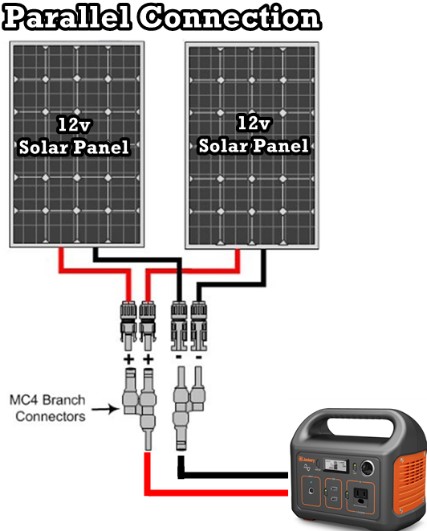
Since solar panels cannot be directly connected to traditional fuel generators, the following three indirect integration solutions must be adopted:
This is the most basic and most common integration method. The system configuration includes solar panels, a charge controller, a battery bank, an inverter, and a traditional generator as a backup power source.
The specific connection process is as follows:
- Step 1: Solar panels are connected to the battery bank through a charge controller. The function of the charge controller is to regulate voltage and current, prevent battery overcharging or over-discharging, and extend battery life. Charge controllers are divided into PWM (Pulse Width Modulation) and MPPT types. MPPT controllers have higher efficiency but are relatively more expensive.
- Step 2: The battery bank is connected to the inverter, which converts the stored DC electricity into AC power for household appliances. The inverter power selection should be determined based on the total electricity demand, and it is generally recommended to reserve a margin of 20% to 30%.
- Step 3: The traditional generator is connected to the system as a backup power source. When solar energy is insufficient or the battery level is too low, the generator is started to charge the batteries or directly supply power to the load. This configuration achieves energy complementarity: relying on solar energy on sunny days and using the generator during rainy weather or at night.
There are some specially designed hybrid generators on the market that have built-in solar charge controllers and inverters, allowing them to receive both solar and fuel inputs simultaneously. Such equipment usually includes the following interfaces:
- Solar input ports for direct connection to solar panels
- Fuel input system supporting gasoline, diesel, or propane
- Built-in battery bank for energy storage
- AC output ports for direct power supply
Before using a hybrid generator, it is essential to carefully review the product specifications to confirm the solar input voltage range, maximum power limits, and whether simultaneous dual-source input is supported. Technical parameters vary significantly between different brands and models, and incorrect configuration may result in equipment damage.
This solution is suitable for scenarios with high requirements for power continuity. The system achieves seamless switching between solar energy and the generator through an Automatic Transfer Switch (ATS).
The working logic is as follows: when the solar system has sufficient power, the switch automatically selects solar supply; when the battery voltage drops below a preset threshold, the switch automatically switches to generator power. The entire process requires no manual intervention, ensuring that critical equipment does not lose power.
The installation of a transfer switch requires professional electrician work, involving modifications to the main circuit and grounding protection. For ordinary household users, it is recommended to hire qualified solar technicians for design and installation.
To build a complete hybrid system of solar and generator power, the following equipment is required:
The power range is typically between 100W and 400W, and the specific choice depends on electricity demand and installation space. For household backup systems, a total power of no less than 400W is recommended; for outdoor portable use, 100W to 200W foldable panels are more practical.
When selecting, attention must be paid to open-circuit voltage (Voc) and maximum power point voltage (Vmp) to ensure compatibility with the charge controller’s input range. In winter use, low temperatures increase panel output voltage, so a safety margin must be reserved.
The charge controller is the core regulating device of the system, responsible for managing the flow of electricity from solar panels to the battery. The main types include:
- PWM Controller: Lower cost, mature technology, suitable for small systems. Efficiency is about 70% to 80%, and performance decreases in environments with large temperature differences.
- MPPT Controller: Can track the maximum power point in real time, with efficiency above 95%. Particularly suitable for high-power systems or environments with significant temperature variations. The price is usually 2 to 3 times that of PWM controllers.
When selecting a controller, it is necessary to confirm that its rated voltage (12V, 24V, or 48V) matches the battery bank and that the maximum input current is not lower than the short-circuit current of the solar panels.
Batteries are used to store solar energy for use at night or during cloudy days. Common types include:
- Lithium Batteries: High energy density, long cycle life (usually more than 2000 cycles), low self-discharge rate, but higher cost. Suitable for weight-sensitive or frequent charge/discharge scenarios.
- Deep-Cycle Lead-Acid Batteries: Lower cost and mature technology, but lower energy density, shorter cycle life (about 500 cycles), and require regular maintenance. Suitable for budget-limited and fixed installation systems.
Battery capacity calculation should be based on average daily electricity consumption and the number of autonomy days required. For example, if daily consumption is 2 kWh and 3 days of autonomy are needed, the battery capacity should be at least 6 kWh (considering 80% depth of discharge, the actual configuration should be 7.5 kWh).
The inverter converts DC electricity from the battery into AC power. The following parameters should be considered:
- Rated Power: Should be greater than the total power of all devices that may run simultaneously.
- Peak Power: Some devices require high startup current, so the inverter must handle surge loads.
- Waveform Type: Pure sine wave inverters are suitable for all household appliances, while modified sine wave or square wave inverters are cheaper but may damage sensitive equipment.
Used to enable manual or automatic switching between solar power and generator power. Manual switches are low cost but require human operation; automatic switches can complete switching instantly during power outages and are suitable for unattended scenarios.
As a backup power source, gasoline, diesel, or propane generators can be selected. Gasoline generators start quickly and are relatively quieter, suitable for intermittent use; diesel generators are fuel-efficient and durable, suitable for long-term operation; propane generators have cleaner emissions and safer fuel storage.
After understanding the system configuration, several critical technical details must be mastered during actual operation. These directly affect system safety, stability, and service life. The following five points must be emphasized:
All equipment in the system must have coordinated voltage levels. The open-circuit voltage of solar panels must not exceed the maximum input voltage of the charge controller; the rated voltage of the battery bank must match the charge controller and inverter; the output voltage of the generator must be compatible with the system voltage.
Common configurations: 12V systems for small portable applications; 24V systems for medium household backup; 48V systems for high-power off-grid installations with lower line losses.
During system design, electricity demand must be carefully calculated:
List all devices that require power, record their rated power and daily usage time, calculate daily energy consumption (power × time), and sum to obtain total daily consumption.
For example: LED light 10W for 5 hours (50Wh), refrigerator 100W for 24 hours (2400Wh), phone charging 20W for 2 hours (40Wh), total daily consumption 2490Wh (about 2.5 kWh).
Based on total consumption, determine solar panel capacity (considering average sunlight hours), battery capacity (considering autonomy days and depth of discharge), and inverter power (considering simultaneous loads and surge current).
Solar generation efficiency decreases significantly in winter, making diesel generators especially important as backup power. Improper configuration may lead to system instability.
- Generator sizing principle: the rated power of the diesel generator should be at least 1.5 times the inverter’s rated power. For example, a 5 kW inverter requires a generator of at least 7.5 kW, and an 11 kW inverter requires at least 16.5 kW.
- Common issue: many users purchase low-power generators that cannot support high-power inverters. When the inverter supplies loads and charges batteries simultaneously, total demand may exceed generator capacity, causing voltage drops, unstable frequency, or shutdown.
- Solution: use small generators only for battery charging instead of powering loads. Configure a dedicated charger or small inverter for emergency charging.
- Automatic management: modern off-grid inverters often include generator input ports, allowing automatic start/stop based on battery voltage thresholds. Short, efficient charging cycles can significantly reduce fuel consumption and noise.
Solar panels must never be directly connected to fuel generators. A charge controller must always be used. Inverter power must match generator capacity. Proper grounding is essential to prevent electrical hazards. Professional consultation is recommended for systems involving main circuit modifications.
Energy independence, cost efficiency, environmental protection, reliability, and emergency support are the primary benefits. Solar power handles daily needs, while the generator ensures performance under extreme conditions, creating a balanced and resilient energy solution.
Home backup systems, outdoor camping and RV use, off-grid living in remote areas, disaster relief operations, and mobile workstations such as surveying or film production.
Solar panels can be connected to a generator, but the method depends on the generator type. Modern solar generators support direct connection, while traditional fuel generators require indirect integration through batteries, charge controllers, and inverters. Building such a hybrid system requires careful planning, proper equipment selection, voltage compatibility, and strict safety measures. Although the initial setup is complex, it provides an optimal balance between the clean, economical benefits of solar energy and the reliable, high-power output of traditional generators.
