
Marine diesel generators are indispensable power sources for ships, yachts, and offshore platforms. These generators are specifically designed for harsh marine environments and are capable of providing reliable and efficient electricity to navigation systems, communication equipment, lighting, and other critical onboard devices. Whether on fishing vessels, cargo ships, or luxury yachts, marine diesel generators play a crucial role in ensuring smooth and safe vessel operation. For example, a 50 kW marine diesel generator can be powered by a Weichai WP4.1CD66E200 engine, which offers both durability and efficiency.
Compared to land-based generators, marine generators differ significantly in design and performance. Firstly, marine generators use corrosion-resistant materials to withstand salt-laden air and high humidity. Secondly, their compact designs allow them to fit into the limited space of ship engine rooms. In addition, marine diesel generators often employ heat exchangers or keel cooling systems instead of traditional radiators. Finally, they must meet safety certification standards from classification societies such as CCS, ABS, BV, or DNV. Marine diesel generators work by converting the chemical energy of diesel into mechanical energy via the engine, which is then converted into electrical energy through the generator. The cooling system, exhaust system, and control panel ensure that the generator operates safely and stably even under the dynamic conditions at sea.
Ordinary land-based generators are not suitable for marine environments. The harsh conditions at sea, including moisture and salt spray, can severely affect conventional generators. While land generators are robust and durable, they are unable to withstand the complex operating conditions at sea. Marine generators, designed for offshore and maritime operations, can endure seawater exposure, high humidity, and adverse weather conditions while providing stable power to onboard systems.
The specific differences between marine and land generators include:
- Materials and Protection: Marine generators use corrosion-resistant materials for the casing and internal components, allowing them to resist salt spray for extended periods. Land-based generators lack such protection and will quickly corrode if used at sea.
- Cooling System: Marine generators typically use heat exchangers or keel cooling systems, utilizing seawater or the ship’s structure to dissipate heat. Land-based generators usually employ conventional air-cooled or water-cooled radiators, which are insufficient for marine applications.
- Structural Dimensions: Marine generators are compactly designed to fit into confined engine rooms, while land-based generators tend to be larger and require more installation space.
- Certification Standards: Marine generators must pass the certifications of authoritative classification societies such as CCS (China), ABS (USA), BV (France), or DNV (Norway) to ensure safety and reliability at sea.
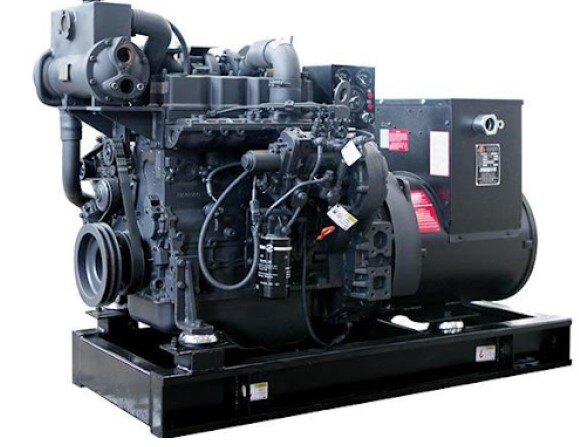
The operation of marine diesel generators can be divided into two main stages.
- Diesel Engine Stage: Diesel fuel’s chemical energy is converted into mechanical energy. Combustion of diesel in the engine cylinder produces high-temperature, high-pressure gases that drive the piston. The piston’s linear motion is converted into rotational motion via the crankshaft.
- Generator Stage: The engine’s rotational motion drives the generator rotor, inducing alternating current (AC) by cutting through magnetic lines of force.
During this process, the cooling system removes heat generated by the engine to prevent overheating. The exhaust system expels the combustion gases outside the vessel. The control panel monitors critical parameters such as voltage, frequency, oil pressure, and water temperature to ensure the generator operates safely.
Marine diesel generators are suitable for all types of vessels, with different ships having distinct power requirements:
- Fishing Vessels: Used for powering lighting, radar, and processing equipment. Fishermen may work at sea for months, and without generators, modern electrical appliances and living facilities cannot be used. Even a single-person small fishing boat may require a generator to supply basic equipment, ensuring the crew’s living and working conditions.
- Cargo Ships: Serve as navigation and cold-chain backup power. Cargo ships need to power numerous communication and navigation devices, deck machinery, and refrigerated containers, requiring generators with continuous operational capabilities.
- Passenger Ferries: Power lighting, communication, and air conditioning systems. Passenger ships need to provide a comfortable environment for a large number of passengers, requiring stable and continuous power supply.
- Oil Tankers: Require explosion-proof configurations. Since they transport flammable cargo, the onboard generator must meet strict explosion-proof standards.
- Yachts: Prioritize quiet, compact power to operate luxury amenities. Due to limited space and high noise control requirements, yachts often use soundproof marine generators.
In the oil and gas industry, offshore drilling platforms have a particularly high demand for generators. Offshore drilling requires large amounts of electricity to operate machinery, while the platform itself functions as a “miniature city” hosting numerous workers. Offshore generators supply power to both machinery and personnel, ensuring continuous and safe operation.
Marine researchers, divers, and biologists who live and work onboard for extended periods also rely on generators to maintain a relatively comfortable living environment at sea. In these situations, generators must withstand waves, salt spray, and high humidity; without such capabilities, offshore work and modern living cannot be sustained.
After understanding the basic features and applications of marine diesel generators, the next critical question is: how can one select a generator suitable for their vessel among the many models and brands on the market? Choosing incorrectly can lead to wasted investment, insufficient power supply, equipment damage, or safety hazards. The following sections cover selection methods and considerations from power requirements, load analysis, engine matching, and cooling method selection.
Accurately determining generator capacity is crucial. Generators must supply power to critical equipment, including lighting, navigation and communication systems, pumps, air conditioning, and emergency systems. Insufficient capacity may cause power interruptions, equipment failure, or inability to meet peak loads, while excessive capacity increases fuel consumption and operational costs.
General steps for power calculation:
- List all onboard electrical equipment and their power ratings, such as lighting, HVAC, pumps, refrigeration, communication, and emergency systems.
- Calculate continuous power requirements (running power).
- Consider starting currents. Many motor-driven devices require 2–3 times running power at startup, especially pumps and air conditioners.
- Apply a safety factor of 1.25 to accommodate extra loads and future expansion.
Calculation formula:
Recommended Generator Capacity = (Running Power + Starting Power) × 1.25
Example: A 12,000-ton deck barge has lighting (5 kW), air conditioning (10 kW), pump systems (12 kW), refrigeration (8 kW), and communication/navigation systems (3 kW), totaling 38 kW running power. Starting power at 1.5× running power = 57 kW. Applying the safety factor 1.25 gives 71.25 kW, so a 75 kW generator is recommended.
Different load types significantly affect generator requirements:
- Resistive Load: Lighting and heating—stable and minimal impact.
- Inductive Load: Motors, HVAC—require additional power at startup, often 2–3× running power.
- Nonlinear Load: Computers, LED lighting—may introduce harmonics and voltage distortion, requiring good voltage regulation.
Marine generators are typically powered by dedicated marine diesel engines capable of delivering high torque at low RPM, fuel efficiency, and reliability. Engines such as Cummins QSB7-DM and MTU 20V4000G22 can run continuously for long periods.
Modern marine generators feature electronic control modules (ECM) to monitor engine speed, fuel consumption, oil pressure, and temperature in real time. ECMs optimize engine operation, adjust fuel injection timing and quantity, provide automatic start-stop functions, and protect against low oil pressure, overheating, or overspeed.
Cooling methods are an essential factor in generator selection. Common methods include:
- Direct Seawater Cooling: Low cost but corrosive; long-term use can damage engine components.
- Keel Cooling: Hull-mounted coolers exchange heat with seawater without direct contact; reliable with low corrosion risk.
- Heat Exchanger Systems: Intermediate coolant transfers heat between engine and seawater; requires regular maintenance.
Adequate engine room space is required for the generator and auxiliary components (fuel, cooling, exhaust). Fuel type should ideally match the main engine to avoid additional storage or piping. Some generators may use hydraulic power from the main engine, but these are limited to when the main engine runs and are generally unsuitable as independent power sources.
Marine generators serve as both main and backup power sources. Regulations and operational safety standards require that if one generator fails, another can power critical equipment without voltage drop. Therefore, at least two generators are usually necessary. Safety systems should monitor low oil pressure, low coolant flow, high coolant temperature, and high exhaust temperature to protect operations. Generators must comply with CCS, ABS, BV, or DNV certification standards.
Proper usage determines long-term stability:
- Load Matching: Operate generators at 25–80% of total capacity. Avoid low-load operation (<25%) to prevent carbon buildup and engine wear.
- Speed and Noise Control: Maintain RPM for proper frequency (50/60 Hz). Use soundproofing and vibration mounts to reduce noise and vibration.
- Efficiency and Long-Term Operation: Generators should operate near rated capacity without overload, leaving ~10% margin for peak load.
- Difference from Inverters: Inverters supply limited power from batteries, insufficient for full-vessel operations.
Marine diesel generators are the core of onboard power systems, directly affecting vessel safety and operational efficiency. From power calculation and load analysis to cooling method selection, every step is critical. Despite their higher cost, choosing underpowered units to save initial expenses risks overload, insufficient power, and higher long-term costs.
When purchasing, consider power requirements, installation space, cooling methods, noise control, safety systems, and long-term efficiency. Prioritize certified products with automatic protection features, and ideally configure two or more generators to ensure continuous power for critical systems. Through proper selection and maintenance, marine diesel generators can provide stable, efficient, and safe electricity for vessels navigating even the harshest marine environments.
