
In industrial, commercial, and residential power environments, a stable and reliable power supply is crucial. Whether it is driving heavy equipment, operating HVAC systems in hotels, or providing backup power for residential communities, selecting a suitable generator set is not just about the brand; more importantly, it is about understanding the meaning behind its performance parameters. One of the most common mistakes users make when purchasing a generator set is confusing the concepts of kVA and kW. This misunderstanding may lead to insufficient equipment capacity, frequent shutdowns, and even increased operating costs. Therefore, correctly understanding the relationship between the two is the foundation for ensuring stable operation of a power system.
- What is kW (Kilowatt): kW is the abbreviation of "kilowatt" and represents active power, that is, the effective electrical energy that a generator can actually provide and use to drive equipment. It represents the part of power that truly performs work, such as driving lighting systems, motors, compressors, or servers. Simply put, kW is the actual electrical power that a generator can use to drive equipment operation. For example, a 50 kW generator means it can provide 50 kilowatts of actual usable power, which is the most critical parameter when engineers perform load calculations.
- What is kVA (Kilovolt-Ampere): kVA is the abbreviation of "kilovolt-ampere" and represents apparent power. It includes the total of active power and reactive power, representing the total power used in the system. Reactive power does not directly perform work, but in inductive load systems (such as motors, pumps, transformers, etc.), it is necessary to maintain electromagnetic field operation. Therefore, generators are usually rated in kVA because it reflects the total output capacity of the equipment rather than only usable power.
- Using a simple analogy: imagine a glass of beer. The total volume of the beer represents kVA (apparent power), the liquid beer represents kW (active power, the part that actually performs work), and the foam represents reactive power (kVAR). Although foam does not perform actual work, it is necessary for the operation of motor magnetic fields. The ratio between liquid and total volume is the power factor.
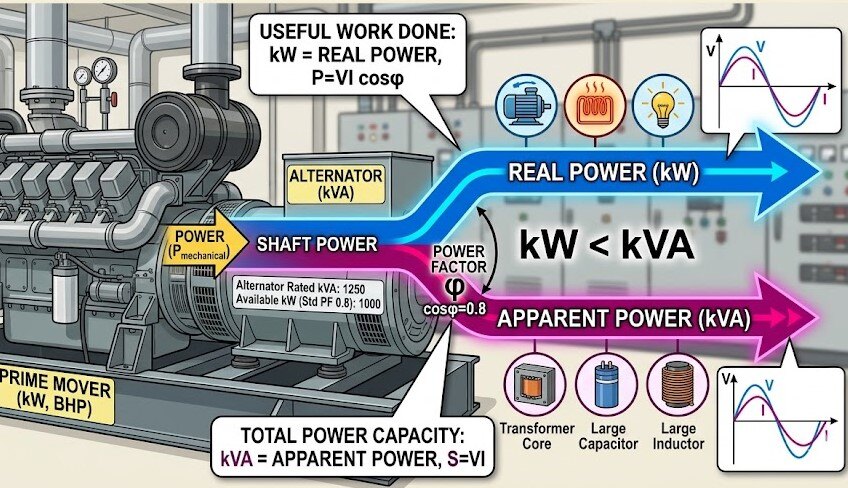
Power Factor (PF) is used to measure the efficiency of electrical energy conversion into effective work, and its value ranges from 0 to 1. The closer the value is to 1, the higher the efficiency of converting electrical energy into effective power.
The calculation formula of power factor is: Power Factor PF = kW ÷ kVA
In practical applications, power factors vary in different scenarios:
Industrial systems: usually around 0.8
Commercial buildings: about 0.85 to 0.9
Residential systems: can be close to 0.9 or even 1
Most diesel generators have a standard power factor of 0.8 (lagging), which means only about 80% of apparent power can be converted into actual active power.
Based on power factor, conversion between kW and kVA can be performed:
From kW to kVA:
kVA = kW ÷ Power Factor (PF)
From kVA to kW:
kW = kVA × Power Factor (PF)
Example 1: A 200 kVA generator with a power factor of 0.8, its actual usable power is:
200 kVA × 0.8 = 160 kW
Example 2: At a power factor of 0.8, a 2 kVA generator has actual usable power of:
2 × 0.8 = 1.6 kW
Example 3: A 2 kW load requires at least the following generator capacity:
2 ÷ 0.8 = 2.5 kVA
After understanding the basic concepts of kW, kVA, and power factor, let us look at the most common mistakes in practical selection. These errors often come from misunderstanding parameter relationships or calculation negligence, which may lead to unstable operation or even equipment damage or production interruption.
This is the most common mistake. If kVA is mistakenly treated as kW during selection, it can lead to serious consequences.
Case study: A building requires an actual 150 kW load but selects only a 150 kVA generator. At a power factor of 0.8, its actual output is 150 × 0.8 = 120 kW. This is clearly insufficient, leading to overload, automatic shutdown, or even equipment damage.
Different load types have different power factors:
Resistive loads (such as lighting and heaters): power factor close to 1.0
Inductive loads (such as motors and transformers): typically 0.6–0.8
Non-linear loads (such as frequency converters and UPS): may be even lower
If these differences are ignored and decisions are made only based on kVA values without actual load analysis, system stability and efficiency will be severely affected.
Motors and compressors may require 1.5 to 3 times (or even 5–7 times) their normal operating power during startup. If the generator does not have sufficient instantaneous load capacity, it may cause voltage drop or system collapse.
Calculation example: Assuming all equipment starts simultaneously, a 67.25 kW load multiplied by a starting factor of 3 equals 67.25 kW × 3 ≈ 201.75 kVA.
After understanding common mistakes, the following introduces a scientific generator selection process. Following this procedure can effectively avoid insufficient capacity or resource waste, ensuring that the selected generator meets current demand while also allowing expansion space.
First, list all equipment requiring power supply and their power ratings. For example, a typical industrial scenario may include:
Compressors (13 HP) 5 units: each about 9.7 kW, total 48.5 kW
Water pumps (1 HP) 25 units: each about 0.75 kW, total 18.75 kW
Total load power: 48.5 kW + 18.75 kW = 67.25 kW
Note: 1 HP ≈ 0.7457 kW, practical calculation can use 0.75 kW.
Using standard power factor PF = 0.8:
Required apparent power = 67.25 kW ÷ 0.8 ≈ 84.06 kVA
If all equipment starts simultaneously, starting multiplier must be considered (usually 2.5–6 times):
67.25 kW × 3 ≈ 201.75 kVA
It is recommended to leave a 20%–30% margin to avoid equipment aging or temporary load increase:
201.75 kVA × 1.2 ≈ 242.1 kVA
Therefore, if all equipment starts simultaneously, it is recommended to select a 250 kVA to 280 kVA diesel generator; if staged starting is possible, a 180 kVA to 220 kVA generator can be selected, but a starting sequence must be designed.
Professional recommendations suggest sizing generators at least 20%–25% above peak load. This "safety margin" prevents continuous full-load operation, significantly extending machine life and protecting warranty rights.
The output power of a generator is limited by two main factors, both of which must be considered:
The engine limitation determines the maximum usable power output of the generator, that is, the electrical power actually used to drive the load. If this limit is exceeded, the engine will be overloaded, resulting in increased fuel consumption, higher temperature, and in severe cases, triggering protective shutdown.
This limitation is mainly determined by current carrying capacity and temperature rise. Under motor starting or low power factor conditions, even if kW has not reached its limit, kVA may reach its limit first, thereby restricting total system output.
Important conclusion: In motor-heavy applications, generators often reach the kVA limit before reaching the kW limit.
Industrial Applications: Industrial facilities usually have a large number of motor loads, with a power factor of about 0.8. Special attention must be paid to: Motor starting current (up to 5–7 times rated current); Sufficient kVA margin; Use of soft starters or variable frequency drives to reduce starting impact.
Commercial Buildings: Commercial buildings (such as hotels and office buildings) have a power factor of about 0.85–0.9. Loads include HVAC systems, lighting systems, elevators, and office equipment. It is recommended to use generators with a power factor of 0.8 and reserve 20%–25% expansion capacity.
Residential Applications: Residential systems have a power factor close to 0.9 or even 1. Main loads include household appliances, lighting, and air conditioning. For single-phase systems, power factor is usually calculated as 1.0, but it should be noted that current in single-phase systems is about 1.73 times higher than in three-phase systems, and cables, switches, and circuit breakers must be properly rated.
Correct understanding of the difference between kVA and kW is the core prerequisite for proper generator selection. Key points include:
kW represents active power, the actual working power.
kVA represents apparent power, the total capacity of the generator.
Power factor determines energy utilization efficiency, typically 0.8 for diesel generators.
Conversion formulas: kW = kVA × PF, or kVA = kW ÷ PF.
Both engine limit (kW) and alternator limit (kVA) must be considered.
A 20%–30% safety margin should be reserved, and starting current impact must be considered.
Work with professional power service providers to ensure reliable and efficient operation under real working conditions.
Only on the basis of accurate load calculation and power factor can a power system ensure both safety and reliability while maintaining economic efficiency and scalability. When purchasing a generator, one must not judge solely by kVA or kW values, but must combine them with power factor conversion to ensure stable operation and avoid overload or insufficient power issues.
