
Imagine this scenario: a sudden power outage in the middle of the night. The refrigerator stops running, the air conditioner shuts down, and your phone is about to die. You reach for your home generator, only to discover the stored gasoline has gone bad—or worse, the nearby gas station is closed due to the outage. This sense of helplessness is why many households start considering a backup generator. But with so many options on the market, the most common dilemma arises: should you choose a propane generator or a gas generator?
These two types are the mainstream choices for home backup power, each with loyal followers and distinct advantages. Propane generators are known for being clean, environmentally friendly, and having stable long-term storage. Gas generators, on the other hand, excel in high power output and easy refueling. Many buyers get overwhelmed by technical specifications or misled by partial sales pitches, resulting in equipment that either fails to meet practical needs or proves troublesome during use.
This guide aims to clarify the decision-making process. We won't overload you with complex technical jargon or hard-to-understand numbers. Instead, we compare propane and gas generators objectively, focusing on practical factors such as fuel supply, operating cost, maintenance, and environmental impact. Whether you're preparing emergency power for your home, equipping an RV for off-grid adventures, or simply exploring which generator suits you best, this article will help you make an informed, practical choice.
Generators convert fuel energy into electricity and are widely used for home backup, outdoor activities, construction sites, and industrial applications. The most common residential generators fall into two categories: propane and gas. Understanding how they work and their characteristics will help you make a smarter choice.
Propane generators produce electricity by burning liquefied petroleum gas (LPG) through an internal combustion engine, functioning similarly to a car engine. To operate, you simply connect a propane tank to the generator and press the start button. Propane is stored as a liquid under pressure and vaporizes into gas during use, mixing with air in the combustion chamber and ignited by a spark plug. The resulting energy drives a turbine, which turns magnets around copper coils to generate AC electricity.
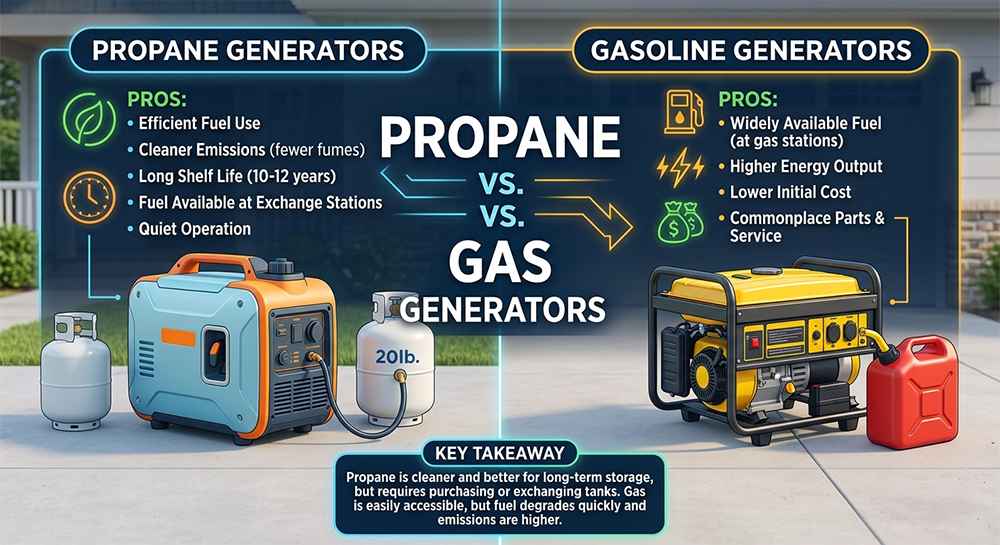
- Long Fuel Storage Life: Propane is highly stable. Unlike gasoline, which degrades in 3–6 months, propane maintains its full energy indefinitely when stored in sealed tanks. This makes propane an ideal choice for backup generators, ensuring they start reliably even after long periods of inactivity.
- Clean and Environmentally Friendly: Propane combustion produces about half the CO₂ of gasoline or diesel and emits significantly lower carbon monoxide. Propane is a sustainable option for users concerned with low emissions. Its clean burn also reduces engine carbon buildup.
- Excellent Temperature Tolerance: Propane works effectively in temperatures from -40°F to 120°F (-40°C to 49°C). Gasoline or diesel engines may lose efficiency or even gel in extreme cold, making propane generators ideal for colder regions.
- High Safety: Stored in pressurized tanks, propane has minimal leak risk. If a leak occurs, propane disperses into the air without accumulating on the ground to form an explosive mixture. It also emits fewer greenhouse gases and particulates than gasoline or diesel, having less impact on indoor air quality.
- Reliable in Emergencies: While gasoline is easy to obtain, most pumps rely on electricity. During outages or natural disasters, gas stations may be closed. Propane tanks can store large amounts of fuel at home safely, providing sustained generator operation without leaving your property.
- Lower Energy Density: Propane produces fewer BTUs per gallon than gasoline, meaning shorter runtime per tank.
- Higher Initial Cost: Propane generators usually cost more upfront than equivalent gasoline models.
- Limited Fuel Availability: Propane is not as widely distributed as gasoline. Users may need specialized suppliers, which can be inconvenient in remote areas.
- Tank Space Requirements: Propane tanks are bulky and heavy, requiring dedicated storage space—potentially an issue for small homes or RVs.
- Higher Maintenance Needs: Higher combustion temperatures may increase engine wear, potentially shortening lifespan compared to gasoline generators and requiring more frequent maintenance.
Gas generators also use internal combustion engines but rely on gasoline or natural gas. Gasoline generators ignite a fuel-air mixture with a spark plug to generate mechanical energy, which spins the rotor to produce electricity. Natural gas generators connect directly to municipal gas lines, eliminating the need for fuel storage and offering convenience.
- Easy Refueling: Gasoline is widely available at fuel stations, and natural gas generators connect directly to pipelines. This convenience makes gas generators ideal for daily use.
- High Energy Density: Gasoline produces about 27% more energy per gallon than propane, allowing longer runtime per fuel unit—a cost advantage for extended use.
- Lower Initial Cost: Gasoline generators are mature, widely available, and usually cheaper than propane models, making them suitable for budget-conscious buyers.
- Long Lifespan: Properly maintained gasoline generators often last longer than propane units and can withstand infrequent maintenance while remaining reliable.
- Wide Power Range: Gasoline generators are available from small portable units under 500W to large industrial models of hundreds of kW, covering everything from home backup to major construction projects.
- Portability: Compact and lightweight designs make gasoline generators easy to move, ideal for camping, fieldwork, or temporary setups.
- Short Fuel Shelf Life: Gasoline degrades in 3–6 months and poses a fire risk if stored long-term, requiring periodic replacement.
- Higher Emissions: Gasoline and natural gas produce carbon monoxide and other pollutants, with higher greenhouse gas output than propane. Outdoor use is required, keeping at least 6 meters from buildings for safety.
- Lower Emergency Reliability: In extreme weather or disasters, fuel stations may be inaccessible, leaving gasoline-dependent users at risk.
- Louder Operation: Gasoline generators are noisier, potentially restricting use in residential areas or campsites.
- Price Volatility: Gasoline costs fluctuate with global markets, geopolitics, and seasonal demand, making long-term running costs unpredictable.
When choosing a generator, evaluate the following dimensions:
If your home has natural gas, gas generators offer plug-and-play convenience.
For portable or remote setups, propane tanks provide independent fuel supply despite occupying space.
Gasoline is the easiest to source but requires careful storage and attention to shelf life.
Propane burns cleaner and emits less, ideal for eco-conscious users or areas with emission restrictions.
Gasoline generators are cheaper upfront; propane may have higher per-gallon cost but benefits from lower storage losses and maintenance, potentially balancing long-term costs.
Gasoline offers higher energy efficiency per gallon.
For occasional power outages, propane's indefinite storage life is ideal.
For frequent, extended use, gasoline's energy density and portability are advantageous.
Dual-fuel generators can run on both gasoline and propane, offering maximum flexibility. Switch to propane when gasoline is scarce, or vice versa. This adaptability is crucial during disasters or prolonged outages. Dual-fuel units are also generally more efficient and environmentally friendly, gaining popularity in the market.
- Home Backup Power: For medium-sized households, backup generators typically require 7–20 kW. If outages are infrequent but you want your generator ready at any time, a propane generator is ideal, as its fuel does not degrade and can be stored long-term without worry. In areas with frequent outages and reliable nearby fuel stations, a gasoline generator is more economical.
- RVs and Camping: RVers and campers need portable, reliable off-grid power. Gasoline generators are popular for their lightweight design and diverse power options, but their noise can affect the camping experience. Propane generators run quieter, and many RVs already have propane systems for heating and cooking, allowing shared fuel use. However, the weight and size of propane tanks require careful planning.
- Agriculture and Industrial Use: Heavy-duty propane generators provide sufficient power for machinery while their clean-burning characteristics help protect equipment. Gasoline generators, with a wide power range and portability, are common on construction sites and for temporary operations.
- Cold Climates: For regions with extremely low winter temperatures, propane generators have a decisive advantage. Diesel may gel in the cold, gasoline may have difficulty starting, but propane can operate reliably even at -40°F (-40°C).
Proper maintenance is essential to ensure generator reliability and extend service life, regardless of type.
Regularly check oil levels and replace oil and oil filters as recommended by the manufacturer.
Clean or replace air filters to ensure proper airflow.
Inspect spark plugs and replace if necessary.
For gasoline generators, run the unit periodically to prevent fuel system blockages.
Follow safety guidelines for fuel storage: gasoline should be in dedicated containers labeled with the date.
Inspect propane tanks, valves, and lines regularly to ensure there are no leaks.
Always operate fuel-powered generators outdoors in well-ventilated areas, away from doors and windows.
Maintain at least a 6-meter (20-foot) distance from the house.
Avoid operating in rain or damp conditions to prevent electric shock.
Keep the generator clear of flammable materials and obstacles.
Turn off and allow the generator to cool before refueling.
Propane and gas generators each have strengths and weaknesses. There is no absolute "best" choice—only the "most suitable" option for your needs.
Choose a Propane Generator if you:
- Need long-term backup fuel storage for infrequent use but want immediate availability.
- Live in cold climates and require reliable low-temperature startup.
- Prioritize environmental sustainability and reduced carbon emissions.
- Already have a home propane system or are willing to install one.
- Value quiet and safe operation.
Choose a Gas Generator if you:
- Require frequent use and maximum energy density.
- Have budget constraints and wish to minimize upfront cost.
- Need portability for use at multiple locations.
- Have easy access to nearby fuel stations.
- Want a wide range of power options, from portable units to industrial-scale generators.
Consider a Dual-Fuel Generator if you:
- Want maximum flexibility in fuel supply.
- Live in areas with extreme weather or potential fuel disruptions.
- Are willing to invest extra for adaptability and environmental performance.
Ultimately, choosing a generator involves balancing cost, convenience, reliability, and environmental impact. Assess your specific needs, location, and usage habits, and use this guide to select the generator that best fits your situation. Regardless of the type, regular maintenance and safe operation are essential to ensure the generator performs when you need it most.
