
In today's industrial and commercial environment, diesel generator sets play a critically important role as reliable standby power sources. Whether responding to sudden power outages or providing stable electricity supply in remote areas where grid access is limited or nonexistent, diesel generator sets are indispensable. However, when selecting and operating diesel generator sets, many users tend to overlook a key issue: power losses. This oversight can lead to improper equipment selection, reduced efficiency, higher operating costs, and shortened service life.
This article provides an in-depth discussion of power losses in diesel generator sets, helping users better understand the underlying mechanisms and adopt effective countermeasures. By doing so, users can select more suitable equipment, improve operational reliability, and significantly extend the service life of their generator systems.
At the core of a diesel generator set is the diesel engine, which generates mechanical power by burning diesel fuel and then drives the alternator to produce electrical energy. A common misconception among users is the belief that the rated power of the diesel engine can be directly equated to the rated output power of the generator set. In reality, this assumption is incorrect.
During operation, the diesel engine inevitably experiences power losses due to various factors, meaning that the actual electrical output of the generator is lower than the diesel engine's rated mechanical power. These losses arise during the conversion of mechanical energy into electrical energy, as well as from internal resistance, friction, and auxiliary power consumption.
Within the industry, a power factor of 0.8 is widely accepted as a standard reference value for practical calculations. This means that if a diesel engine has a rated power of 100 kW, the actual electrical output of the generator set after installation is typically around 80 kW. The remaining power is consumed during the energy conversion process required to drive the generator.
That said, some high-quality diesel engines may achieve a higher effective output, with power factors approaching 0.9, resulting in better overall performance. Even so, power losses can never be completely eliminated.
Unfortunately, some unethical manufacturers exploit users' lack of understanding by directly labeling the diesel engine's power as the generator set's electrical output power, thereby misleading consumers. In reality, there is no diesel generator in the world that can entirely ignore the power factor. If a generator set claims to deliver 100 kW of electrical power using a diesel engine rated at 100 kW, it would clearly violate fundamental physical laws.
As standby power sources, diesel engines also have a concept known as standby power rating. Under heavy load conditions, diesel engines cannot operate continuously for extended periods; typically, standby power can only be sustained for about one hour. As a result, generator sets are often categorized by one-hour power ratings and twelve-hour power ratings. If the user requires the generator set solely for emergency backup purposes, selecting a standby-rated unit may be sufficient.
However, whether for standby or continuous operation, one fundamental principle must always be followed: the diesel engine's power rating must be higher than the generator's electrical output rating. Only under this condition can the generator operate reliably and safely under load.
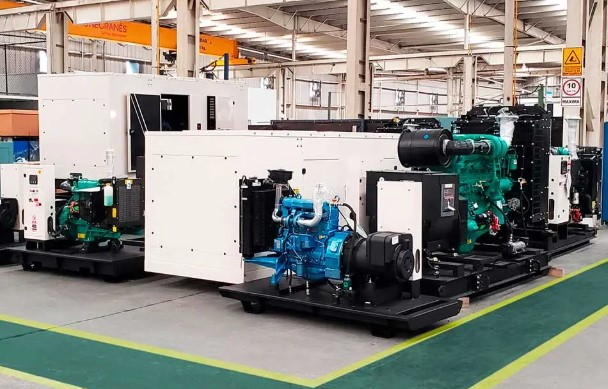
In addition to inherent power conversion losses, environmental conditions also have a significant impact on the performance of diesel generator sets. One typical example is the low-noise generator set.
To reduce operational noise, low-noise generator sets are usually housed in well-sealed soundproof enclosures. While effective at noise reduction, these enclosures can restrict airflow, resulting in slower air intake. Diesel engines require an adequate supply of fresh air to ensure proper combustion. When air supply is insufficient, fuel cannot burn completely, leading to reduced power output and increased carbon deposits inside the engine.
Altitude is another critical environmental factor. In regions located more than 1,000 meters above sea level, atmospheric pressure and air density differ significantly from those at lower elevations. At high altitudes, air is thinner and contains less oxygen, which reduces combustion efficiency within the diesel engine. As a result, the generator's electrical output power decreases accordingly.
Therefore, when using diesel generator sets in high-altitude environments, users must account for this unavoidable power loss during equipment selection and system design.
When purchasing a diesel generator set, users should select the diesel engine based on a power factor of approximately 0.8 and then comprehensively consider additional environmental factors, such as the need for a soundproof enclosure, ambient temperature, and installation altitude. By factoring in all potential power losses, users can choose a generator set that meets actual operating requirements rather than theoretical ratings.
During operation, diesel generator sets inevitably experience various forms of energy loss. These losses not only reduce system efficiency but may also contribute to equipment wear and failure over time. The six most common types of losses during generator operation are outlined below.
Stator copper loss refers to the energy loss generated when current flows through the stator windings of the generator. This loss is proportional to the square of the current, meaning that as current increases, copper loss rises sharply.
Stator copper loss primarily manifests as heat. Excessive heat can increase winding temperatures, which in turn degrades insulation materials and adversely affects generator performance and service life.
Excitation loss occurs in the rotor circuit of the generator due to the excitation current required to establish the magnetic field. This loss mainly consists of copper losses in the excitation circuit.
Like stator copper loss, excitation loss also appears in the form of heat. Excessive excitation loss can raise rotor temperatures, disrupting normal operation and potentially causing long-term damage to the generator.
Iron loss refers to magnetic losses caused by the magnetic flux within the generator. These losses include hysteresis loss and eddy current loss in the stator core, as well as additional stray losses.
Iron loss is closely related to magnetic flux density and operating frequency. Excessive iron loss leads to increased heat generation, which negatively impacts generator efficiency and longevity.
Cable loss occurs during the transmission of electrical energy from the generator set to the distribution panel or load center. This loss is mainly caused by the electrical resistance, inductance, and capacitance of the cables.
Cable losses result in wasted electrical energy and reduced overall system efficiency, particularly when long cable runs or undersized conductors are used.
Mechanical loss includes ventilation losses and friction losses in transmission components. These losses occur due to air resistance, bearing friction, and mechanical contact between moving parts.
In addition to wasting energy, mechanical losses generate extra heat, which can accelerate wear and shorten the service life of mechanical components.
Additional electrical losses include losses caused by leakage magnetic flux at the generator's end windings and losses generated by harmonic magnetic fluxes.
These losses also appear as heat and can accelerate insulation aging, ultimately affecting generator reliability and durability.
Diesel generator sets supplying high-voltage power also experience additional losses during energy transmission. These losses primarily include resistive losses and transmission losses.
Resistive loss occurs when electrical current flows through conductors, generating heat due to conductor resistance. Transmission loss, on the other hand, results from the combined effects of resistance, inductance, and capacitance within power cables.
Moreover, high-voltage power systems often involve transformers, which introduce their own losses. Transformers are used to convert generator output into voltage levels suitable for high-voltage applications, and energy losses are unavoidable during this conversion process.
Therefore, when designing and operating diesel generator systems, it is essential to properly account for and compensate for these losses to enhance system efficiency and reliability.
Generator losses affect not only efficiency but also have a profound impact on equipment lifespan. During operation, nearly all forms of loss eventually manifest as heat. Excessive heat accelerates insulation aging, reduces dielectric strength, and shortens the overall service life of the generator.
For example, during a sudden short circuit, the end windings of the generator are subjected to strong electromagnetic forces, which can deform the coils or damage insulation. Overvoltage in stator and rotor windings can further compromise insulation integrity. The combined effects of surge current and overvoltage may cause insulation breakdown at weak points.
In addition, severe operating conditions can induce intense vibrations, applying destructive mechanical stress to certain structural components.
To effectively extend generator service life, reducing power losses, particularly mechanical losses, is essential. Mechanical losses mainly arise from friction, wear, and energy dissipation in transmission components.
Measures to reduce these losses include regular inspection and maintenance of lubrication systems, ensuring smooth operation of mechanical transmission parts, optimizing operating parameters to eliminate unnecessary energy consumption, and using high-efficiency bearings and seals to minimize friction.
Controlling power losses not only extends generator lifespan but also improves efficiency, reduces energy consumption, and lowers operating costs. By minimizing losses, equipment energy efficiency can be enhanced, failure rates reduced, and overall productivity improved.
To control generator losses at the source, multiple factors must be considered comprehensively. In addition to routine maintenance and parameter optimization, technological innovation and equipment upgrades play a vital role.
For example, adopting advanced energy-saving technologies and high-performance materials can significantly improve efficiency. Introducing intelligent monitoring systems enables real-time tracking of operating conditions, allowing potential issues to be detected and resolved promptly before they escalate into major failures.
Through continuous improvement and optimization, generator power losses can be effectively controlled, enhancing system reliability and extending service life. These efforts are of great significance in improving energy efficiency and reducing overall energy consumption.
Diesel generator sets play an essential role in modern industrial and commercial applications, but the issue of power losses during operation must not be overlooked. When selecting and operating diesel generator sets, users must fully understand power conversion losses, environmental influences on output, various operational loss mechanisms, losses associated with high-voltage power utilization, and the impact of losses on generator service life.
By implementing effective control strategies, such as regular maintenance, optimized operating parameters, adoption of energy-efficient technologies and materials, and the integration of intelligent monitoring systems, losses can be significantly reduced. This not only extends equipment service life but also improves efficiency and reliability.
In conclusion, understanding diesel generator power losses and taking appropriate countermeasures is fundamental to ensuring efficient, reliable, and long-term operation. It is hoped that this article provides valuable insights to help users make informed decisions when selecting and using diesel generator sets.
