
Power quality directly determines how equipment performs during outages or when supplied by small inverter generators. Inverter generator systems typically power mixed loads; some are easy to drive, while others are highly sensitive to voltage fluctuations. Therefore, selecting an inverter generator should begin with understanding load requirements, followed by choosing the appropriate waveform type. The difference between pure sine wave and modified sine wave directly affects equipment temperature, noise levels, and operational stability. Understanding these two waveforms is the key first step in choosing the right inverter generator.
A pure sine wave is the natural form of alternating current (AC), where voltage rises and falls in a smooth, continuous curve, fully consistent with the power supplied by the grid.
Main characteristics include:
- Smooth and continuous power output: Voltage changes follow a perfect curve without abrupt jumps or steps
- Consistent with household power grid waveform: The default standard considered in device design
- Prevents overheating and noise in sensitive devices: Reduces extra heat and electromagnetic interference
- Compatible with almost all modern appliances: From simple lighting to precision medical equipment
Total Harmonic Distortion (THD) of pure sine wave inverter generators is usually below 3%–5%, delivering power quality close to grid standards.
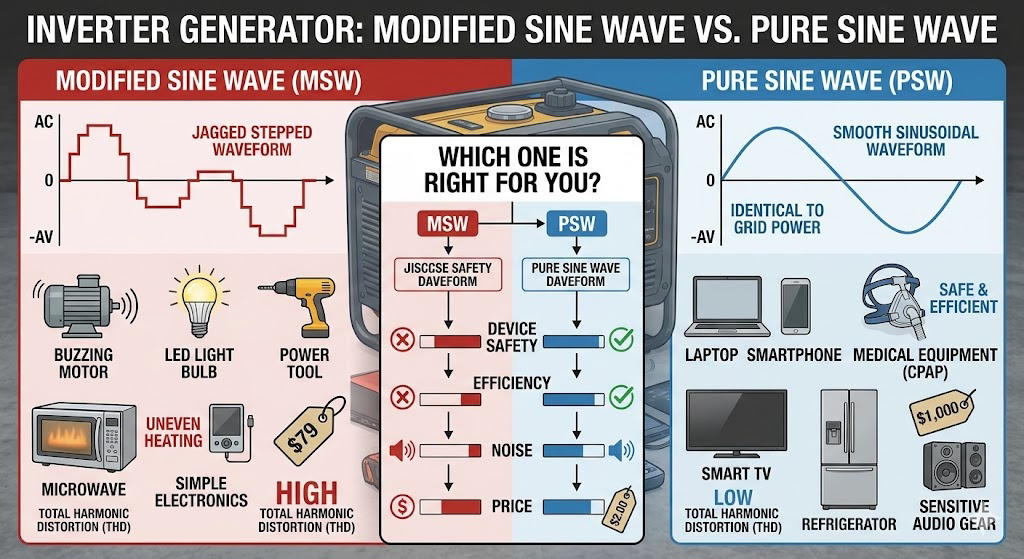
A modified sine wave (also called a quasi-sine wave) uses a stepped or approximate square wave to simulate a sine wave but lacks a smooth curve.
Technical characteristics include:
- Stepped waveform: Simulates the average value of a sine wave through abrupt voltage switching
- Lower cost: Simple circuit design and low manufacturing cost
- Limited applicability: Suitable only for basic resistive loads
- High harmonic content: THD usually ranges from 20%–40%, with an average around 28%
A modified sine wave looks like a circle drawn with short straight lines: similar from afar but rough and angular up close.
Once the technical differences between waveforms are understood, the key is choosing based on actual load characteristics. Different devices vary in sensitivity to power quality, and selecting the wrong waveform may cause damage, efficiency loss, or malfunction. The following are specific recommendations for common load types:
For incandescent bulbs, simple heaters, electric kettles, and other purely resistive loads, modified sine wave can be used when the circuit is in good condition. These devices primarily convert electrical energy to heat and are insensitive to waveform.
However, note that even LED bulbs may produce buzzing under modified sine wave and have long-term burn-out risks.
Devices like phone chargers, small speakers, and laptops should preferentially use pure sine wave. Pure sine wave provides a cooler, quieter operating environment, reducing heat in chargers and adapters.
Measured data shows laptop power adapters can operate 40% cooler under pure sine wave.
Appliances such as refrigerators, water pumps, fans, and vacuum cleaners containing motors or compressors must use pure sine wave. Pure sine wave ensures smoother startup and less heat generation, whereas irregular waveforms can cause vibration, heat, and accelerated wear.
Motor-type loads under modified sine wave may experience:
- Increased operational noise with audible humming
- 15%–20% higher heat generation
- Reduced efficiency and increased power consumption
- Accelerated long-term wear, shortening lifespan
Inverter motor devices, modern refrigerators, and air conditioners must use pure sine wave. Their control systems are extremely sensitive to voltage waveforms, and modified sine wave may cause control board failure or abnormal operation.
Computers, servers, and network devices with active power factor correction (PFC) benefit from pure sine wave, reducing restarts and disconnections. Modified sine wave may trigger protection circuits frequently, affecting normal use.
Medical equipment and precision instruments should consult manuals and prioritize pure sine wave. These devices have the highest power quality requirements, and waveform distortion may lead to equipment failure or even endanger patients.
After selecting the suitable waveform, another critical technical parameter is harmonic distortion, which measures the “purity” of the power output and is a core standard for assessing inverter generator or inverter quality. Understanding harmonic distortion helps evaluate equipment performance more accurately, avoiding hidden losses due to poor power quality.
THD describes the distortion level of AC output waveform and is a core indicator of power quality. The lower the THD, the closer the waveform is to an ideal sine wave, and the more stable the device operation.
Industry standards and grid connection requirements usually control THD under 5%, ideally below 3%. High-quality pure sine wave inverters typically have THD below 3%, while modified sine wave THD may reach 20%–30%.
Modified sine wave output with high harmonics can cause:
- Increased motor heating and noise
- Audible hum or interference in audio equipment
- Charger overheating or abnormal sounds
- Electromagnetic interference affecting surrounding devices
- Neutral line overheating (in three-phase four-wire systems)
Pure sine wave reduces temperature rise and electromagnetic interference, especially when the inverter generator is close to living spaces.
When buying an inverter generator or inverter, check THD under actual load conditions, not just no-load data. If THD rises significantly during startup of devices like refrigerators, pure sine wave power should be chosen.
After solving power sizing and wiring, seamless power switching during outages must be considered. For critical equipment that cannot tolerate interruption, UPS is essential. Waveform quality also determines operational stability; wrong waveform may cause tripping or device reboot.
Pure sine wave UPS is recommended in scenarios such as:
- Unstable grid with frequent voltage dips
- Waveform-sensitive equipment like network devices or medical instruments
- Systems connected to inverter generators
- Critical operations requiring long-term stable power
Core network devices such as modems, routers, and NAS should be prioritized on UPS to ensure uninterrupted connectivity. Monitors and printers can be excluded to extend UPS runtime.
Measure actual load and test UPS performance under real conditions. Verify waveform quality by observing device operation and using instruments like true RMS meters or oscilloscopes, recording voltage and frequency during no-load, normal operation, and startup.
Understanding the importance of pure sine wave is not enough—you also need to verify product authenticity. Some products have vague labels or misrepresentations. Simple verification methods help avoid purchasing non-compliant equipment.
Look for keywords in specs or manuals:
- Pure Sine Wave Inverter
- THD < 3%
- Sine Wave Output
An oscilloscope allows direct waveform observation. Pure sine wave is smooth, while modified sine wave appears stepped or square-shaped.
Test sensitive devices:
Quiet, stable operation → likely pure sine wave
Noise, flickering, or overheating → possibly modified waveform
Common on-site issues include router restarts, motor overheating, or audio noise.
A multimeter cannot show waveform but can detect voltage stability. Large fluctuations under load may indicate a non-pure sine wave output.
If uncertain, contact the manufacturer for detailed technical parameters. Reputable brands should provide THD reports and waveform charts.
- Voltage regulators cannot change waveform: Regulators or simple filters cannot convert modified sine wave into pure sine wave. Sensitive equipment requires double-conversion UPS or pure sine wave inverter, not a regulator.
- Impact on energy consumption: Modified sine wave increases heat and power loss, raising fuel consumption. Pure sine wave is often more cost-effective long-term.
- Warranty requirements: Some equipment warranties require low-distortion sine wave. Using modified sine wave may void warranties, so keep relevant test records.
- Microwave ovens: May experience loud noise and uneven heating under modified sine wave. Use at least 1500W pure sine wave power with sufficient surge capacity.
- GFCI and UPS tripping: Often caused by waveform distortion or improper grounding. Use pure sine wave and ensure proper grounding, then retest under load.
Choosing the correct waveform is fundamental to ensuring safe and stable equipment operation. Pure sine wave, though initially more expensive, protects equipment, improves efficiency, and reduces noise, making it economically beneficial over the long term.
Modified sine wave is suitable only for simple resistive loads and has limitations in noise, heat, and compatibility.
For systems containing motors, variable frequency devices, PFC computers, audio, or medical equipment, pure sine wave should be used with sufficient startup margin. In unstable grids or high-reliability applications, a pure sine wave UPS is essential to ensure critical equipment operation. Ultimately, fully understand actual load characteristics and test devices under real conditions before purchase. Correct waveform selection affects not only performance but also equipment lifespan and operational safety.
