
Diesel generator sets play a vital role as emergency backup power systems across a wide range of applications, including industrial production facilities, commercial buildings, healthcare institutions, and data centers. A properly installed diesel generator set not only ensures reliable power supply during outages but also guarantees long-term stable operation and extends the service life of the equipment.
This article provides a comprehensive overview of the entire installation process of a diesel generator set, helping users fully understand every stage—from pre-installation planning to final acceptance.
Diesel generator sets are complex systems, and every stage, from procurement to final safety acceptance, requires strict control. Among these, the installation phase is particularly critical. To ensure smooth commissioning and long-term reliable operation, systematic pre-installation planning is essential.
Before installing a diesel generator set, the first and most important task is to conduct a comprehensive power demand assessment. This step determines the generator capacity selection and directly impacts both operational performance and investment cost.
Power demand should be evaluated from two perspectives:
- Current maximum load demand
- Future expansion requirements
Many users only consider the power requirements of existing equipment and overlook future growth, which can lead to insufficient generator capacity within a few years. As a result, they are forced to purchase additional equipment. A more practical approach is to reserve a 20% to 30% power margin, which can handle unexpected peak loads and accommodate future expansion.
At the same time, it is crucial to clearly define the purpose of the generator:
- Is it used as an emergency backup power source during outages?
- Is it used for peak shaving to reduce electricity costs during high-demand periods?
- Or is it a primary power source for off-grid or remote locations?
Different applications require significantly different configurations, installation methods, and maintenance strategies.
Choosing the right installation location is fundamental to ensuring efficient generator operation. An ideal site should meet the following conditions:
- Ventilation Requirements: Diesel generator sets produce a large amount of heat during operation. Proper ventilation is essential to dissipate heat and prevent overheating, which can reduce efficiency or cause equipment failure. The generator room should be designed with air inlets and exhaust outlets to ensure smooth airflow.
- Accessibility and Convenience: The installation site should be close to the electrical distribution panel to minimize cable length, reducing both power losses and installation costs. It should also be near the fuel storage area for easy refueling. Additionally, sufficient access must be provided for technicians to perform routine inspection and maintenance.
- Space Allocation: Adequate maintenance space must be reserved around the generator set: At least 1 meter on both sides; More than 1.5 meters at the rear; More than 2 meters at the front; Sufficient overhead clearance for lifting and maintenance. Proper spacing not only facilitates maintenance and component replacement but also ensures effective heat dissipation, preventing premature wear and failure. In the long run, proper space planning significantly reduces maintenance costs.
The installation and operation of diesel generator sets are strictly regulated. Ignoring compliance requirements can result in fines, shutdowns, or legal risks.
- Noise Control: Different regions have specific noise limits. Equipment should comply with local standards, and soundproof enclosures or silencers may be required. The generator room should be located away from offices and residential areas.
- Emission Requirements: Diesel engine emissions are regulated by environmental laws. Low-emission equipment should be selected, and additional devices such as catalytic converters or diesel particulate filters (DPF) may be required. In some cities, emission standards are as strict as those for road vehicles.
- Fuel Storage Regulations: Diesel fuel is classified as a hazardous material. Storage systems must comply with standards such as UL certification. Tanks should include leak prevention designs and secondary containment systems (e.g., bund walls). Detailed records of fuel storage—including delivery dates, quantities, and quality reports—must be maintained to meet regulatory requirements.
Zoning and Permits: Before installation, local zoning regulations must be reviewed to confirm whether diesel generators are permitted in the area. Necessary permits must be obtained from local authorities to ensure legal installation and operation.
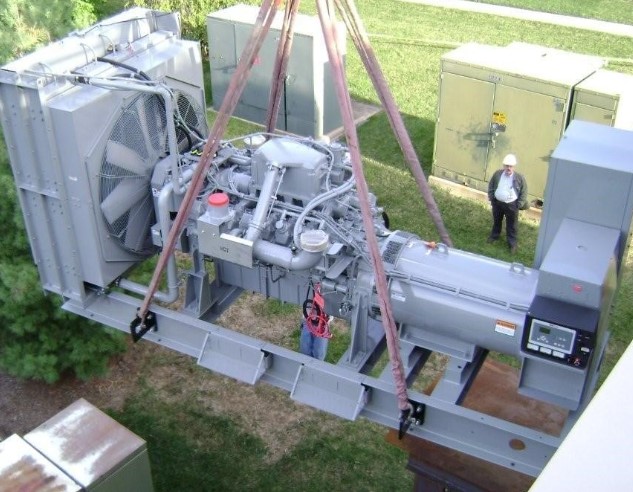
After completing planning and site preparation, the generator set can be delivered to the site. Due to its large size and weight, strict procedures must be followed during transportation and inspection.
Diesel generator sets are heavy and require careful handling:
Use high-strength steel wire ropes for lifting
Attach lifting equipment only to designated lifting points
Avoid binding ropes to fragile components such as bearings, oil pipes, or instruments
Handle equipment gently to avoid vibration and impact
Transport routes must be planned in advance, considering road load capacity, bridge limits, turning radius, and clearance height.
If installation cannot be performed immediately after delivery:
Store the generator in a dry indoor location
If outdoor storage is unavoidable, elevate the unit and cover it with waterproof material to protect against rain and sunlight
The generator room must provide sufficient access for equipment transportation. If doors or windows are too small, walls may need to be partially removed before installation and restored afterward. This must be planned during the construction phase to avoid costly modifications later.
Upon arrival, unpacking inspection is critical:
- Check packaging for damage, deformation, or water exposure
- Verify the number of packages against the shipping list
- Follow proper unpacking sequence (top first, then sides)
After unpacking:
- Verify all components and accessories (generator set, silencer, flexible pipe, control panel, tools, spare parts)
- Inspect for damage, deformation, or corrosion
- Pay special attention to core components such as engine, alternator, and radiator
If installation is delayed:
- Reapply anti-rust oil to machined surfaces
- Do not rotate moving parts before removing protective coatings
- Keep the unit level and seal all openings to prevent contamination
After inspection, installation begins with proper foundation construction and accurate positioning.
Before installation:
- Mark centerlines, damper positions, and reference lines based on design drawings
- Ensure alignment accuracy within specified tolerances:
- ±20 mm between unit and wall/column center
- ±10 mm between multiple units
The foundation must support both static and dynamic loads:
- Typically constructed with reinforced concrete
- Designed based on unit weight and soil bearing capacity
- Surface flatness tolerance: ≤0.1 mm per meter
Anchor bolts must be accurately positioned. Anti-vibration trenches may be included to reduce vibration transmission.
During installation:
- Use proper lifting equipment
- Avoid stressing shafts or damaging components
After placement:
- Align with foundation centerlines
- Adjust level using shims
Leveling accuracy must not exceed 0.1 mm per meter in both longitudinal and transverse directions.
Once the generator set is properly positioned and leveled, the installation of auxiliary systems can begin. Among these, the exhaust system must be prioritized, as it directly affects engine performance and operational safety.
The exhaust system directly affects engine performance and lifespan:
Minimize pipe length and number of bends
Excessive bends increase back pressure and reduce engine power
Flexible bellows must be installed near the turbocharger outlet to absorb vibration.
Two main installation methods:
Overhead installation: fewer bends, lower resistance
Trench installation: better heat dissipation but more complex
Exhaust pipes can reach temperatures above 500°C, so insulation is essential. Materials such as fiberglass or aluminum silicate should be used, with metal cladding for protection.
Keep exhaust pipes away from combustible materials
Allow space for thermal expansion
Ensure proper waterproofing where pipes exit the building
Each generator must have an independent exhaust system to prevent interference and backflow.
After the exhaust system installation is complete, the electrical system installation should proceed simultaneously. Serving as the critical link between the generator set and the electrical load, the quality of the electrical system installation directly determines both the reliability of power supply and the safety of operation.
Cable installation methods include direct burial, cable trenches, or wall mounting. Routing should:
Follow the shortest path
Minimize bends
Avoid mechanical damage and corrosion
Reserve 1.5% to 2% extra cable length for maintenance.
For backup systems, an ATS is essential:
Automatically switches load to generator during outages
Switches back when utility power is restored
The ATS should be installed near the distribution panel, with separate control and power wiring.
Grounding must comply with NEC and local codes:
Use dedicated grounding electrodes
Ensure all metal parts are bonded
Proper grounding protects both equipment and personnel.
Once the electrical system installation is completed, attention shifts to configuring the fuel system. As the primary energy source for the diesel generator set, the safety and reliability of the fuel system are directly linked to the unit’s continuous operation and the fire safety of the generator room.
Fuel tanks must meet capacity and safety requirements:
Day tank: 8–24 hours of operation
Main tank: based on refueling cycle
Tanks should include level gauges, vents, and fire protection devices.
Use high-quality piping
Install filters and water separators
Ensure leak-free connections
Regular maintenance is essential.
Equip with fire extinguishers, foam systems, and sand
Clearly mark emergency exits
Establish emergency response procedures
After the installation of the exhaust, electrical, and fuel systems is complete, the generator set enters the overall commissioning phase. Through standardized startup tests and load verification, the installation quality can be thoroughly evaluated, ensuring that the equipment is ready for full operational deployment.
Before startup:
Check oil, coolant, and fuel levels
Inspect belts and connections
Verify electrical systems and grounding
Start with no-load operation
Gradually increase load
Monitor voltage, frequency, temperature, and pressure
Acceptance includes:
- Installation quality
- System performance
- Safety compliance
- Documentation review
All technical documents must be archived for future reference.
During the selection and installation of diesel generator sets, users often encounter common questions. The following section addresses several typical concerns to help users better understand and operate their diesel generator sets.
Q: Can I install a generator myself?
A: No. Installation involves complex systems and must be performed by qualified professionals.
Q: What is the difference between a generator and a generator set?
A: A generator converts mechanical energy into electricity, while a generator set includes the engine, generator, control system, and auxiliary components.
Q: Can a generator be plugged directly into a household outlet?
A: Absolutely not. This is extremely dangerous and can cause equipment damage or serious injury.
Proper installation of a diesel generator set is the foundation for reliable and long-term operation. Every stage—from planning and site preparation to transportation, installation, and commissioning—must be carefully managed.
By complying with regulations, prioritizing safety, and implementing proper maintenance practices, users can fully realize the benefits of diesel generator systems as dependable emergency power solutions. It is strongly recommended to work with professional manufacturers and installation teams to ensure successful project execution and reliable power supply.
